
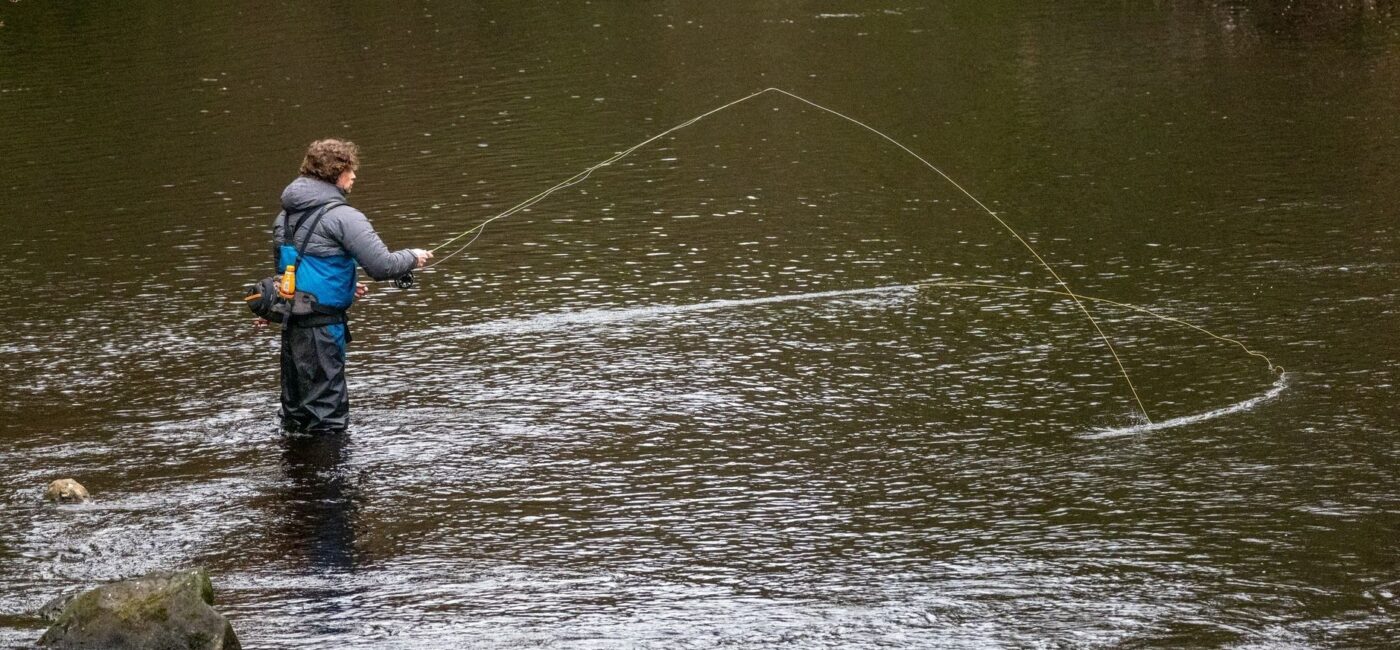
Reading the Dynamic Waters of Southwest Scotland
The River Nith is one of southwest Scotland”s most varied migratory fisheries. From the upland catchment, where rain can turn rocky channels into energetic spate water, the river travels through progressively gentler country before reaching the broad, tide-influenced reaches around Dumfries and the Solway Firth. That journey creates several distinct angling environments within one river system, rather than a single set of conditions that can be approached in the same way from source to sea.
Anglers who treat the Nith uniformly often miss the central tactical question: what is the river doing here, today, and why? Gradient controls current speed and the shape of holding water, while discharge affects clarity, temperature and fish movement. Farther downstream, tidal back-up changes water levels and current direction, sometimes compressing the useful fishing window around an ebb or slack-water period. A useful geographical overview is provided by the River Nith”s catchment description, which follows the river as it descends across southwest Scotland toward the Solway Firth.
Hydrological Contrast Across the Upper and Lower Catchment
Above Thornhill, the Nith has the character of a river shaped by upland relief. Around Drumlanrig and through the upper valley, steeper gradients encourage faster surface water, broken runs and concentrated flow around bedrock, boulders and ledges. The river does not need to be exceptionally high to become powerful in such terrain. A modest rise can put extra force into the heads of pools, narrow the safe wading margin and make the most productive lies those areas where current velocity eases abruptly.
Farther downstream, the valley opens into a flatter alluvial landscape. The channel becomes less dominated by rock steps and more influenced by deposited gravel, silt, bankside erosion and the wider floodplain. Pools can be longer and less sharply defined, with holding water forming along inside seams, crease lines, deep outside bends and areas where the main flow loses energy. The lower river is also subject to tidal influence, so its water level and current cannot be understood from rainfall and upstream discharge alone.
| Upper Nith characteristics | Lower Nith characteristics |
|---|---|
| Steeper gradient and quicker current | Lower gradient with slower, broader flow |
| Boulder, cobble and bedrock features | Alluvial bed, softer margins and deposited sediment |
| Shorter pools, pocket water and turbulent heads | Longer pools, glides, seams and tide-affected holding areas |
| Spate response can be rapid | River discharge interacts with tidal rise, fall and sediment movement |
The difference also matters for juvenile fish. Fast, oxygenated pocket water and shallow runs can provide valuable rearing habitat when flow and substrate are suitable, while slower lower-valley margins offer a different mixture of depth, cover and food availability. For the angler, the practical lesson is to read the riverbed before selecting a fly. Upper beats reward close observation of hydraulic structure, whereas lower beats demand attention to depth, visibility, tidal timing and the direction in which water is actually moving.
Tackling the Upper Nith Above Thornhill
Upper Nith fishing is often an exercise in controlling depth and maintaining contact in water that is moving faster than it first appears. Steep pool heads, bedrock ledges and boulder fields create numerous small lies, but fish may occupy only the softer edge of a current tongue or the cushion immediately behind an obstruction. A careful approach begins upstream of the intended cast, with wading kept to a minimum and the first casts covering the near bank, the tail of a pocket and the inside edge of the main flow.
A switch rod is a sensible tool where bankside vegetation or confined casting space limits a full overhead stroke. A responsive shooting head allows changes in depth and casting distance without constantly rebuilding the line system. Density-compensated sinking tips can be particularly useful because they help the fly descend consistently through uneven current, rather than hinging sharply at the junction between floating and sinking sections. The aim is not simply to fish as deep as possible, but to keep the fly travelling at a controlled speed through the likely lie.
- Use a compact switch or salmon rod suited to the beat and the conditions, with a line system that allows quick changes in depth.
- Carry floating, intermediate and sinking tips, including heavier options for steep pool heads and rising water.
- Choose visible flies when broken water makes tracking difficult, especially in low light or peaty colour.
- Use heavy tungsten tubes when the current is strong, but shorten the cast and prioritise safe control over distance.
- Cover pocket water methodically, allowing the fly to fish beside rocks, below ledges and along the slower edge of each current tongue.
Fly choice should follow presentation rather than fashion. High-visibility patterns make sense in turbulent water because they help the angler monitor the drift and judge whether the fly is holding its depth. Heavy tungsten tubes can reach fish in deeper slots, particularly after a spate begins to drop, while smaller or lighter patterns may be better when levels are low and clarity improves. A practical example from Nith fishing has been the use of a one-inch Willie Gunn tube with a floating, hovering and sinking line combination, although no individual pattern should replace observation of water height and fish behaviour.
Safety deserves equal billing with tackle. Upper-bank paths can be slippery after rain, and a boulder that was manageable on the previous visit may become hazardous under increased flow. A wading staff, belt, suitable footwear and a decision to retreat when the river rises are basic necessities. Do not assume that a familiar pool remains safe at a different height, and always confirm current permits, beat boundaries and local rules before fishing.
Decoding Tidal Push and Estuary Beats Below Dumfries
Below Dumfries, the river must be read as a combined river and estuarine system. An incoming tide can push water upriver, raising levels and reducing the apparent downstream flow. In suitable shallow, funnel-shaped estuarine geometry, the flood can form a steep advancing front known as a tidal bore. Bore behaviour depends on tidal range, channel shape, depth, width, friction, river discharge and local constrictions, so it should never be assumed that every tide will produce the same visible effect or travel the same distance.
The practical effect for anglers is a changing hydraulic picture. A fish that was comfortable on the edge of a falling river may move when the tide backs up, while running fish can pause in deeper or quieter water as current pressure changes. The most productive period is often not the entire tide but a defined window around the transition, especially the slack period when velocity is temporarily reduced before the next phase becomes dominant. Lower-water ebbs can also expose seams and margins that are difficult to identify when the channel is full.
- Check the river level, recent rainfall and the predicted tidal state before leaving for the beat. Treat tide tables as planning tools, not substitutes for observation on the bank.
- Arrive early enough to watch the direction and speed of the current. Look for floating debris, changed colour boundaries and the first signs of water backing into side channels.
- Fish the low-water ebb and the slack-water transition deliberately, concentrating on deep edges, creases and areas where running fish can rest.
- When the water is clear and fish are nervous, lengthen the leader, reduce unnecessary false casts and present the fly at an angle that avoids lining the fish.
- Rotate pools and stands fairly, leaving room for other anglers and moving through the beat in an orderly direction.
Intermediate lines and long leaders are often more versatile in the lower reaches than very aggressive sinking systems. They allow a fly to settle without plunging unnaturally through shallow or moderate-depth water. Stealth matters because broad lower-river pools can give fish time to inspect a presentation, particularly in clear conditions and calm weather. Smaller, subdued patterns can be appropriate, while a slightly more visible fly may be justified in coloured water, during low light or when the current is strong enough to make tracking difficult.
Downstream fishing also demands careful attention to bankside conditions. Tidal margins can be soft, slippery and deceptively deep, while flood debris may collect against vegetation or structures. Before planning a day around Dumfries, Dumfries visitor information can help with general regional planning and amenities, but fishing access, permits, local restrictions and current river conditions still need to be confirmed with the relevant fishery or association.
Gauge Reading and Spate Management from Source to Sea
Gauge data is useful only when interpreted as part of a moving system. The SEPA station at Drumlanrig provides an important upper-catchment reference, with a digital record extending back to 1967 and a catchment area listed as 471 square kilometres. On 5 October 2026, the station page reported a level of 0.583 metres at 3:00 am, classified as Normal and falling. Such a reading is a snapshot, not a guarantee of conditions on every beat, and the station warns that data is provisional, may be delayed and can later be revised.
Compare the gauge trend with rainfall, air temperature, tributary response and what is visible at the river. Peaty spate water may arrive quickly, carry suspended colour and then clear in stages. The upper beats often become fishable first during the falling cycle, when the strongest turbulence begins to settle but sufficient depth and movement remain. Downstream, the signal is delayed and modified by channel storage, tributary inflows, floodplain effects and tidal sediment. Allow time for that lower-river water to settle, and remember that a falling upstream gauge does not automatically mean a falling estuarine beat.
- Use SEPA”s station list or map as an initial condition check, while recognising that readings may be provisional or incomplete.
- Record whether the level is rising, steady or falling, rather than relying on the number alone.
- Match water colour and velocity to fly depth, leader length and casting distance.
- Expect the upper river to react before the lower river, where tidal influence can delay or reverse the apparent trend.
- Reassess on arrival, especially after intense rainfall, strong coastal winds or a marked change in tide.
Mastering the River Rhythm from Mountain to Solway
The Nith rewards anglers who adapt presentation to physical setting. Above Thornhill, success often comes from finding small cushions of slower water within fast, oxygen-rich current and using a controlled sinking presentation to reach them. Below Dumfries, the essential questions become broader: how much of the movement is river discharge, how much is tide, where is the slack developing, and how has visibility changed since the previous phase of the tide?
Good river etiquette is part of effective fishing. Confirm licences and beat permissions, follow current salmon and sea-trout regulations, handle fish with wet hands, keep them in the water whenever possible and observe local catch-and-release requirements. Rotate pools, avoid crowding, leave gates as found and do not wade through lies that another angler is covering. Before stringing up, spend several minutes watching the surface, reading the margins and checking the latest gauge and weather information. On the Nith, that pause is not wasted time. It is the first and often most important tactical decision of the day.